Why MCP is the Key to Unifying the MarTech Stack and Scaling AI

Manago AI is the new name for SALESmanago. Read our rebrand story here

The eCommerce landscape is clear: AI is the future of growth. But this promise is constantly being challenged by a single problem: fragmentation. We must shift from a situation where integrating two systems takes months of engineering work to where complexity is handled by the platform, and we can focus on business execution.
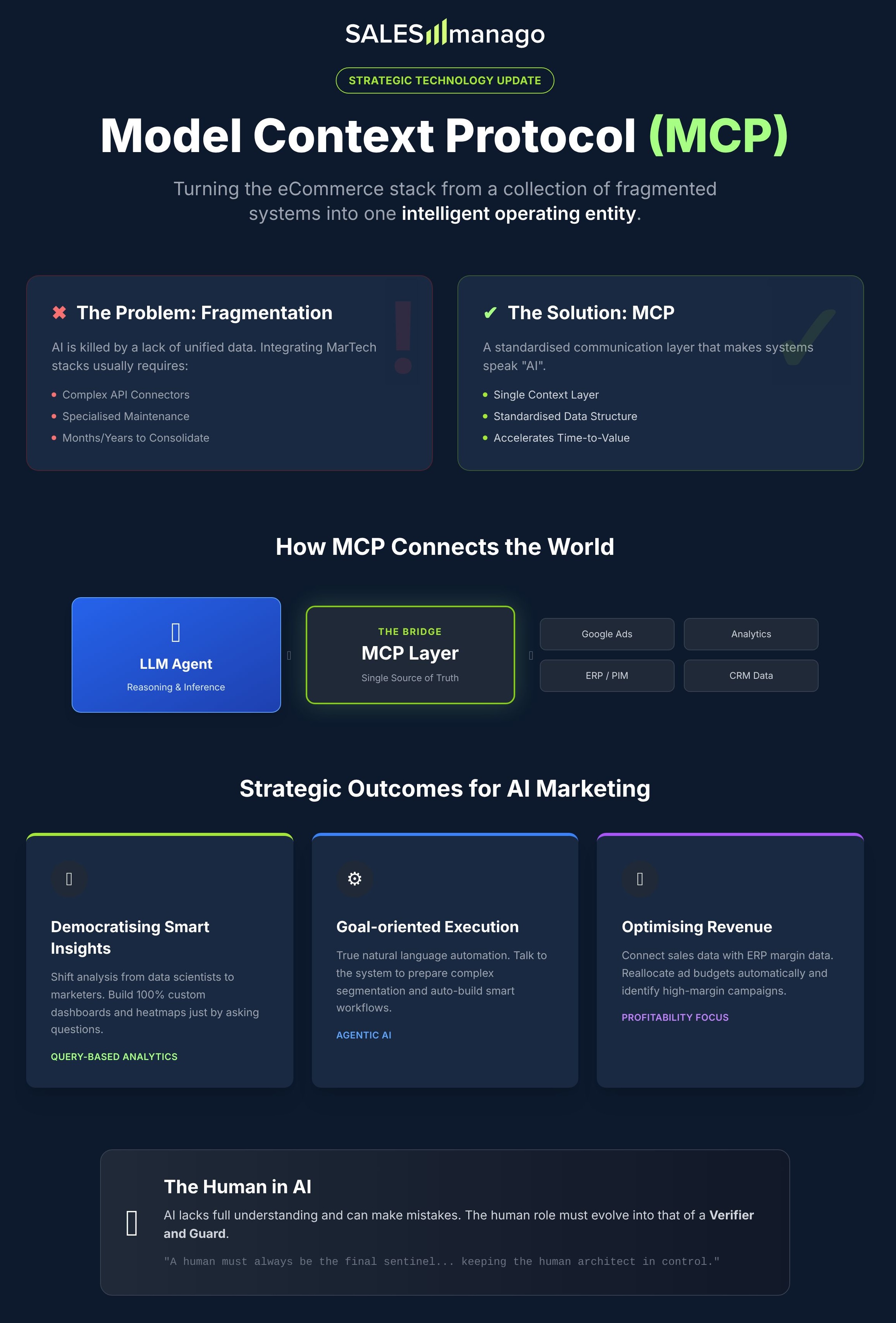
As CTO at Manago AI my focus is on solving this fundamental problem. And the answer is the Model Context Protocol (MCP). This is the strategic layer that is turning the eCommerce stack from a collection of fragmented systems into one intelligent operating entity.

AI is not killed by lack of algorithms but by lack of unified data. The reality is that integrating systems used to require technical specialists, API connectors, continuous testing and maintenance – a continuous, highly specialised job. This created fragmented technological stacks, often taking months or years to consolidate. This is especially true in MarTech where the stack is highly fragmented in larger organisations and is a hidden cost for them. The high-level goal of MCP is to solve this by accelerating growth.
>> Read also How to Supercharge Every Stage of Your AI Lifecycle Marketing
The technical beauty of MCP is that it serves as a single context layer. The whole concept was created to deliver precise data and context to large language models (LLMs) for reasoning and inference. This protocol is evolving fast and is becoming the standard for delivering information to LLMs in a structured way.
But how does a single protocol achieve what years of complex API projects failed to deliver? MCP is an open, standardised communication layer that shifts the focus from a proprietary CDP to an open protocol for context and data access. The key is that the LLM can use, link and infer relationships between different data sets because we provide the context description of the data. This creates a Single Source of Truth for every AI agent.
The LLM Agent can connect to arbitrarily many MCP servers built on top of different systems like Google Ads, Google Analytics and ERP providers. This multi-system connectivity means that a non-technical person can combine several tools and get the desired integration effect just by talking to the computer. This eliminates the friction of traditional development cycles and accelerates time-to-value.
Getting all this context unified is a major strategic advantage; it simplifies the marketer’s workflow and accelerates growth.
MCP changes data analysis, moving it from the hands of specialised data scientists directly to the marketer. For example, the Manago AI platform allows to generate dedicated analytics, smart insights, market research and deep data analysis just by writing a query. Users can request to create 100% custom business dashboards on demand, analyze campaign performance and even build CTR heatmaps by channel/time to recommend optimal send times. Moreover, the system can research data online to build rich contact profiles and update CRM data with data gathered from Manago AI and external sources.
This unification enables true natural language automation. The platform can now execute campaign goals (segmentation, content, execution) based on a conversation, a task that used to take hours of manual work. Users can talk to the system to prepare complex user segmentation, which the platform understands and prepares for confirmation. This moves marketers into the next horizon of Agentic AI where the system auto-builds smart workflow templates and executes complex, multi-step tasks.
Finally, MCP’s connectivity allows us to focus on profitability across the entire business. This includes providing predictive targeting by recommending the “Next Best Audience” using dynamic RFM+ segments and using AI-driven attribution modelling to recommend (or automatically reallocate) ad budgets between channels like Meta Ads and Google Ads. Crucially, we can connect sales data with product profitability (PIM, ERP) to automatically identify best performing campaigns vs margin and recommend pricing and cross-sell bundles.
It’s pretty obvious to anyone who has ever used AI agents but AI models can make mistakes. They lack full understanding in some cases and even pose risks like data leaks that can lead to reputational damage and legal issues.
The human role must therefore evolve into that of a verifier and guard. Despite the powerful capabilities of AI, a human must always be the final sentinel for the process, verifying results and minimizing potential mistakes. Full control must never be surrendered to the technology. At Manago AI our focus is on enabling efficient, secure tools while keeping the human architect in control of the strategic vision.



Marketing automation has become harder to evaluate precisely because almost every platform now sounds the same. More AI, more automation, more intelligence, more promises to do more with less. Some of that represents genuine progress. Some of it is familiar functionality with a new label. For ecommerce teams, the useful question is not which platform has the longest ...
Read more
At some point, usually in a meeting that was supposed to be about something else, someone asks a very simple question: how many customers do we actually have?Finance checks the order system. Marketing checks the email database. The numbers do not match, and the gap is too large to dismiss as a reporting quirk.
Read more
You have more customer data than you have ever had. It is sitting in Shopify, in your email tool, in the helpdesk, in your ad accounts, in the POS system at the till. Literally more than you know what to do with it. The problem is that none of it is in the same place, so the same shopper shows up as different strangers depending on which platform you happen to be loo...
Read more