Martech trends: 5 shifts marketing teams should watch in August 2026

Manago AI is the new name for SALESmanago.Read our rebrand story here


August brought another stack of AI announcements, product launches and “this changes everything” headlines. Most of them will be forgotten by the time we write the September edition.
A few developments are harder to shrug off. Google is starting to give marketers actual data on visibility inside AI search. Product discovery keeps leaking out of the places retailers used to control. AI projects are running into the same old problem of messy customer data, only now the consequences are more obvious. And the EU AI Act has moved transparency from something to prepare for into something teams need to deal with now.
There is an interesting backdrop to all of this. Scott Brinker’s 2026 marketing technology landscape lists 15,505 products, just 0.79% more than last year. Yet 1,488 products appeared and 1,367 disappeared.
So the martech market has not exactly put its feet up. It is replacing parts while the engine is running.
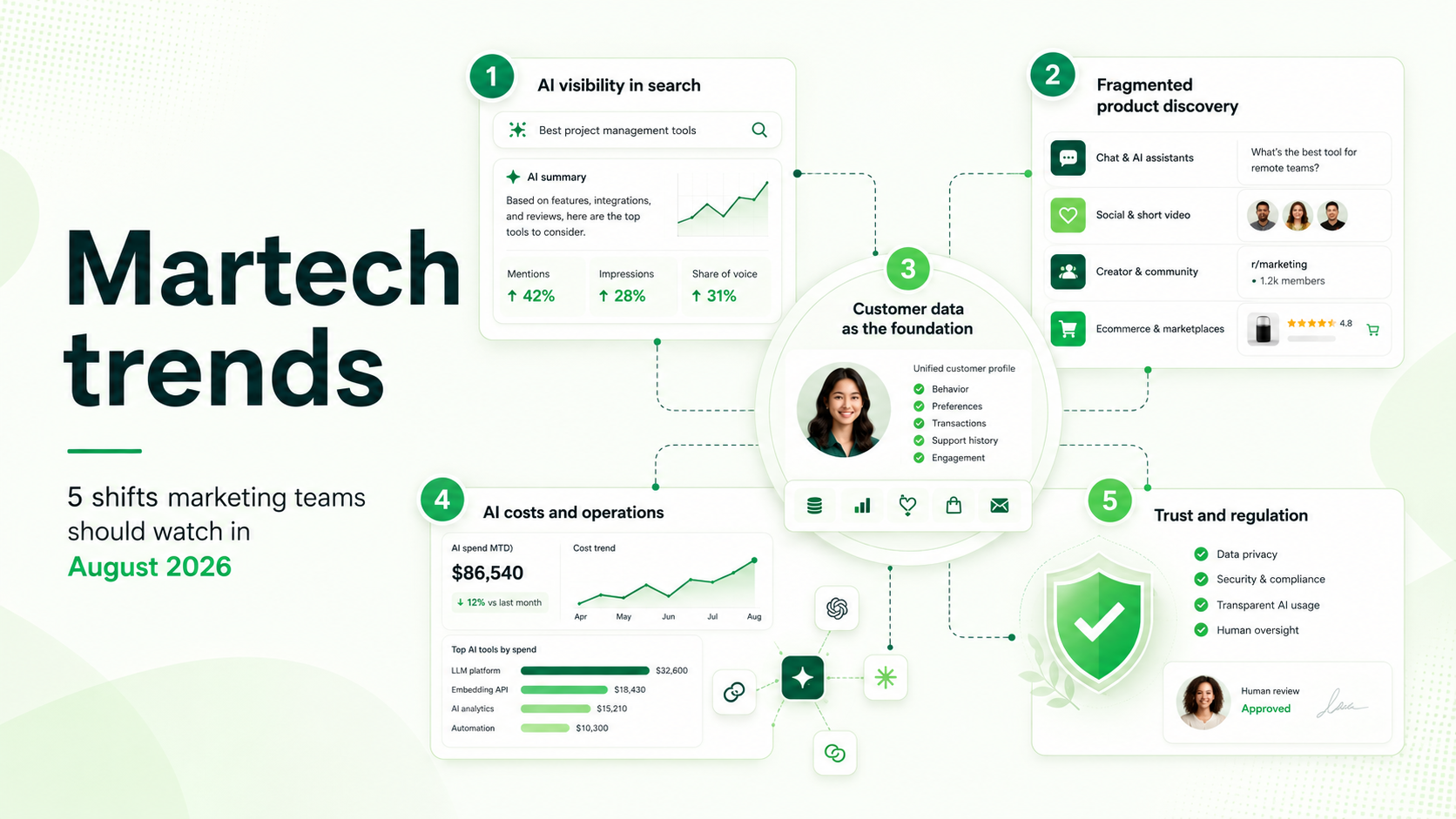
Here are the five changes we think are worth paying attention to this month.
For two years, marketers have been asking some version of: “Are we showing up in ChatGPT, Gemini and AI search?”
The uncomfortable follow-up was usually: “Good question. Sort of.”
Google has now made that conversation a little more useful. Search Console reports impressions from AI Overviews and AI Mode, with breakdowns by page, country, device and date. There is still no click data, so nobody should be throwing their SEO dashboards away just yet.
What this does give us is a clearer signal that traditional rankings and AI visibility are not the same thing. A brand can rank well in search and still have a weak presence in generated answers. And being cited is not necessarily the same as being recommended.
Consumer behaviour is also getting more complicated. In 2025, 82% of surveyed consumers said AI search was more useful than traditional search. In 2026 that fell to 54%, a 28 point drop in twelve months, while 70% said they were using AI search tools more often than the year before.
People are using the stuff more while trusting it less. Very internet.
For marketing teams, I would treat AI visibility as a separate line in reporting rather than trying to squeeze it into the SEO box. Organic rankings still matter, but they no longer tell you everywhere a customer might encounter your brand before visiting the site.
The classic funnel was always tidier in PowerPoint than it was in real life. AI search and social commerce are making the gap almost comical.
Someone looking for a new pair of trainers might start with ChatGPT, see a creator discussing them on TikTok, check Reddit for complaints and only visit the retailer once they have narrowed the choice down to two models. The website is still important, but it may join the conversation much later than the retailer would like.
That changes what counts as marketing infrastructure.
Digital Commerce 360’s AI commerce rankings look at whether AI agents can access catalogue data, how much traffic comes from AI-powered discovery, whether it comes from several engines and whether that traffic is growing.
These sound like feed-management questions until your products fail to appear in the places people now use to decide what to buy.
For eCommerce teams, catalogue quality therefore deserves a seat at the marketing table. If an AI system cannot read your product data properly, the campaign creative sitting three folders away in Figma is not going to rescue the situation.
I’m not saying the funnel is dead. Marketers have already attended enough funerals for the funnel. It is simply becoming harder to pretend that discovery happens mainly on channels we can neatly map and measure.
A disappointing AI project often kicks off the same troubleshooting routine: change the model, tweak the prompt, try another agent.
Sometimes that helps. Sometimes it is like changing the SatNav because the road itself ends in a field.
If purchase history sits in one platform, browsing behaviour in another and consent data somewhere else, AI is still working from fragments. A better model can make smarter use of context, but it cannot invent customer context that was never connected in the first place.
That is one reason the CDP category is changing. Gartner points towards intelligent customer context engines, where unified customer data becomes the memory AI needs to reason and act, rather than simply a database marketers query before a campaign.
The everyday version of this problem is less theoretical. It is the CSV export before Monday’s send, two segments that should contain the same customers but somehow do not, or a personalisation rule built on data that is already a day out of date.
This is the layer our platform is built around.
Manago AI connects behavioural, transactional and consent data into one customer profile that can be used for segmentation, personalisation and automation. The same customer context can then power predictive, generative, recommendation and agentic AI.
That means an AI feature does not have to start every task by assembling its own half-complete version of the customer.
The team still decides what goes live. AI gets better context; marketers keep control.
We cover the data side in more depth in our article on CDP examples.
A lot of early AI business cases could be summarised as: automate the work, spend less.
If only budgets behaved that politely.
Gartner says CMOs are now putting 15.3% of marketing budgets into AI, while only 30% report being mature enough to scale it. Labour’s share of marketing spend has actually risen from 21.9% to 24.5%.
The missing piece is all the work around the AI.
A new agent may remove an hour of manual campaign work, then introduce API costs, monitoring, integration work and another process somebody needs to own. None of this means the technology is a bad investment. It does mean that counting only the task you automated gives you a pretty flattering version of the economics.
There is also no prize for using agentic AI where a simple rule would do the job. Rule-based automation, predictive models, generative AI and autonomous agents solve different problems and carry different running costs.
Sometimes the boring option wins. Marketing operations tends to have a good memory for that lesson.
August also marks a much less optional martech development.
Since 2 August 2026, Article 50 of the EU AI Act has applied, bringing disclosure requirements for providers and deployers of certain AI systems.
For marketing teams, “deployer” is the word to notice. Using another company’s AI model does not automatically mean all responsibility lives with that company. If your organisation puts customer-facing AI into use, you need to understand what obligations sit on your side.
The regulation is arriving at an awkward time for consumer trust. Mintel reports that half of UK consumers think the risks of AI outweigh the benefits, even though 45% say AI features can make products more appealing.
That sounds inconsistent until you look at control. People tend to be happier with AI when they feel they are choosing to use it. Enthusiasm drops when an algorithm starts quietly making important decisions for them.
For marketers, this makes “human in the loop” more than a reassuring phrase for a slide deck. Someone needs to decide who reviews AI output, at which stage and how much freedom the system has before that review happens.
Those details are not nearly as exciting as launching the agent. They are also the bits you will care about when something goes wrong.
None of these trends requires an emergency martech rebuild. A few sensible checks would go a long way:
Add AI visibility alongside organic search reporting.
Check whether AI systems can access and understand your product catalogue.
Map which customer data your AI tools can actually reach.
Use the simplest level of automation that can reliably handle each job.
Review customer-facing AI against Article 50 disclosure requirements.
Scott Brinker summed up the broader shift neatly: AI does not remove the constraints on innovation, it moves them from building things to making them matter.
That is probably the thread connecting this month’s five trends. We have plenty of AI already. The harder job is making sure it can find the right data, show up in the right places, earn customer trust and produce something worth the money being spent on it.
By September, there will undoubtedly be another crop of new tools to talk about. The teams making real progress will probably be spending at least as much time getting the current ones to work properly.
No. AI visibility gives you another view of brand discovery, while traditional SEO reporting still covers information AI reporting does not. For now, you need both.
Because the automated task is only one part of the cost. AI also brings integration, infrastructure, evaluation and governance work that has to be paid for somewhere.
It can, depending on where the AI system or its outputs are used. This article is not legal advice, so check your organisation’s situation with a qualified adviser.
Find out where the data currently lives and which systems can actually use it. Adding another AI tool before fixing fragmented customer context usually gives the new tool the same old problem.



Marketing automation has become harder to evaluate precisely because almost every platform now sounds the same. More AI, more automation, more intelligence, more promises to do more with less. Some of that represents genuine progress. Some of it is familiar functionality with a new label. For ecommerce teams, the useful question is not which platform has the longest ...
Read more
At some point, usually in a meeting that was supposed to be about something else, someone asks a very simple question: how many customers do we actually have?Finance checks the order system. Marketing checks the email database. The numbers do not match, and the gap is too large to dismiss as a reporting quirk.
Read more
You have more customer data than you have ever had. It is sitting in Shopify, in your email tool, in the helpdesk, in your ad accounts, in the POS system at the till. Literally more than you know what to do with it. The problem is that none of it is in the same place, so the same shopper shows up as different strangers depending on which platform you happen to be loo...
Read more