Agentic AI vs generative AI: what's actually different, and which one should be doing the work?

Manago AI is the new name for SALESmanago.Read our rebrand story here


Here's the short version: gen AI writes the email. Agentic AI builds the campaign around it, sends it, and tells you how it did. One produces something. The other finishes something. Once you see the difference that way, most of the confusion around these two terms disappears.
Generative AI creates content on request: a paragraph, an image, a line of code. You ask, it answers, the conversation ends there until you ask again. Agentic AI is built to take a goal rather than a single instruction, work out the steps needed to reach it, and carry a good number of them out itself.
That's the textbook version, and it's accurate. But it undersells what's actually going on. Both technologies sit inside the same broader field of artificial intelligence, and both are built on machine learning, with large language models doing most of the heavy lifting in the tools you'll actually use day to day. Generative AI and agentic AI aren't two separate species of artificial intelligence. Agentic AI is closer to gen AI with a job description attached.
Putting it simply: generative AI produces content reactively, in response to a prompt, while agentic AI manages multi-step workflows on its own, keeps track of what's already happened, and reaches for external tools when it needs them.
Reactive versus proactive is the cleanest way to hold the distinction in your head as you read on.
Generative AI, or gen AI as most people now shorten it to in conversation, is the AI most of us have already used, probably this morning. It's the technology behind ChatGPT, and behind the "write me a subject line" box that's crept into most marketing tools over the last two years. It became a mainstream tool in late 2022, when large language models first showed they could generate convincing text, images, code and audio just by learning patterns from enormous datasets.
What matters for a marketer isn't the model architecture. It's what the tool actually does for your afternoon.
A generative AI model, usually a large language model, is one of several machine learning models trained on huge volumes of text or images using deep learning. Natural language processing lets it understand what you're asking for, and generative AI models turn that understanding into an output you can actually use. Give it a prompt, it hands back an output. That's the whole loop. There's no ongoing plan, no memory of what it did for you yesterday, no next step waiting in the wings unless you write another prompt.
This is precisely why gen AI is so fast to get value from. There's no agent standing behind it deciding what to do next, just you and the prompt box. There's nothing to configure, nothing to approve in advance. You ask, you get something back, you edit it or you don't.
In a marketing team, generative AI tools tend to show up in the same handful of places, over and over:
Drafting subject lines, email copy, and product descriptions.
Producing image and video variants for a campaign.
Summarising a long report so someone doesn't have to read all thirty pages.
Translating a campaign into another market's language.
Turning one asset into three or four formats for different channels.
None of this is glamorous. It's also, quietly, where most of the time savings from gen AI tools have actually landed for marketing teams over the past couple of years, long before agentic AI entered the conversation.
If gen AI is the intern who's brilliant at the first draft, agentic AI is closer to the colleague who takes the brief, builds the whole thing, and comes back with it ready for your sign-off. It doesn't wait for a second, third, and fourth prompt. It works out what those next steps should be on its own.
Agentic AI is rarely built from scratch. Underneath, there's usually still a generative model doing the reasoning and the language generation. What changes is everything wrapped around it, the agentic AI framework that gives it structure: memory of what's happened so far, a planning layer that breaks a goal into steps, and the ability to call on other tools and systems to get those steps done. Databricks describes it as a supervisor agent that takes a goal and hands pieces of it to specialised sub-agents, each completing its part and passing the result along, without a person triggering every single handoff.
Zoom into any agentic AI framework and you'll find the same basic unit doing the work: an AI agent, a component built to make a decision and act on it without being walked through every step. String several AI agents together, each handling its own piece of a goal, and you end up with what most people call agentic AI systems.
In everyday use, "AI agent" and "agentic AI" get used almost interchangeably, and both point at the same idea: AI with enough agency to make decisions and carry out a multi-step task without being walked through it. A few people draw a sharper line between one AI agent doing a job and agentic AI as the wider system several agents operate inside, but for a marketing team deciding what to actually use, that's a difference of emphasis, not of technology.
Worth a moment of honesty here too: agentic AI isn't magic, and it isn't finished growing up. As things stand in 2026, agents still need a human to sign off on anything consequential, and they work within boundaries someone has deliberately set for them. That's exactly how the better implementations are built: scoped sensibly, with a person kept in the loop.
Agentic AI is worth reaching for when a task is really several tasks stitched together, not one, and each bullet below is really a job for an AI agent working quietly through the steps in between:
Turning a single campaign brief into a built audience, a drafted email, and a schedule.
Watching a workflow and rerouting it, or flagging it to a person, the moment something changes.
Coordinating a multi-step customer service case across more than one system.
Running the analysis and coming back with a recommended next move, rather than just a chart.
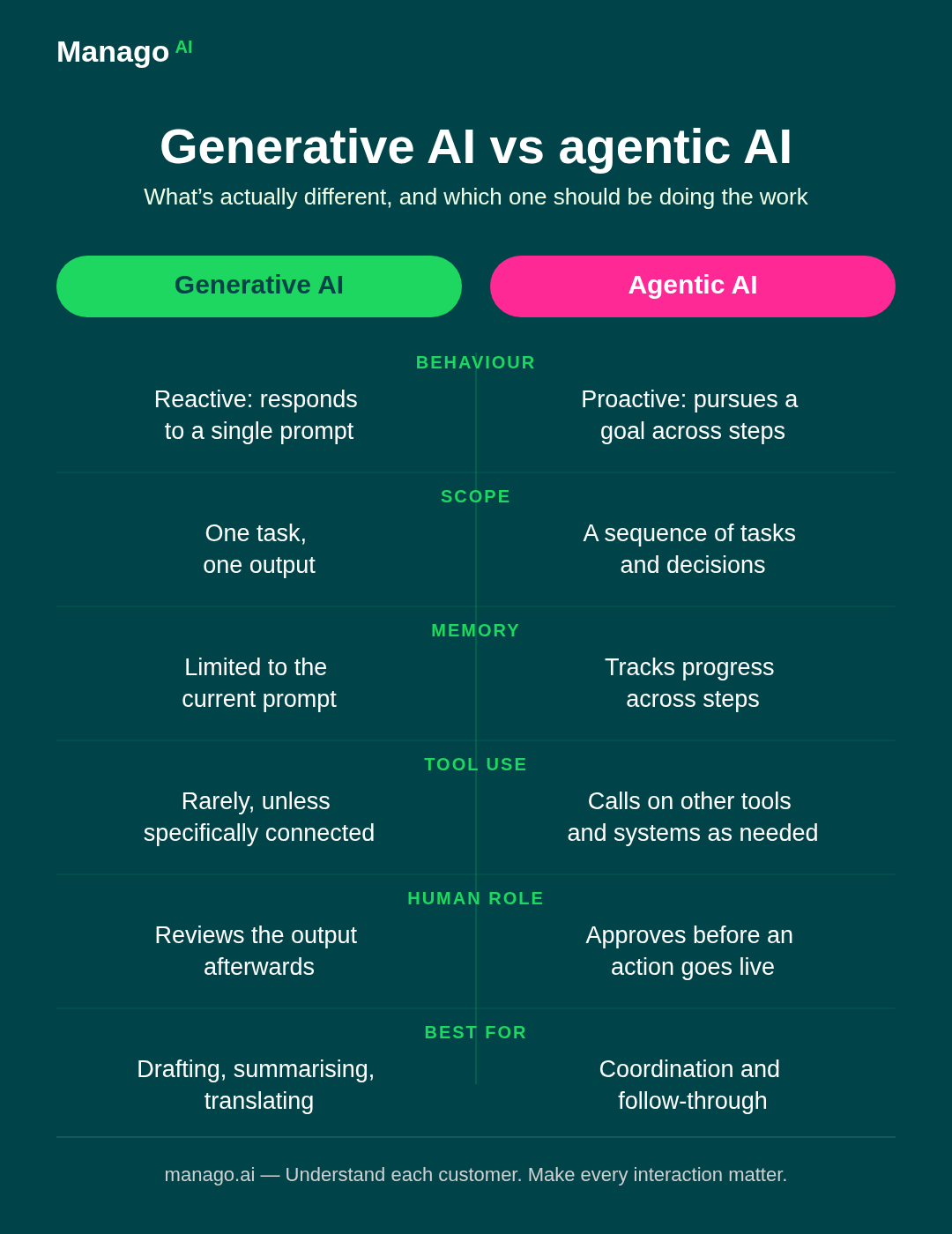
| Generative AI | Agentic AI | |
|---|---|---|
| Behaviour | Reactive, responds to a prompt | Proactive, pursues a goal across steps |
| Scope | One task, one output | A sequence of tasks and decisions |
| Memory | Limited to the current prompt | Keeps track of progress across steps |
| Tool use | Rarely, unless specifically connected | Calls on other tools and systems as needed |
| Human role | Reviews the output afterwards | Usually approves before an action goes live |
| Best for | Drafting, summarising, translating | Coordination, follow-through, multi-step work |
Here's the bit most comparison articles skate past: the two aren't actually separate categories that happen to sit next to each other. Agentic AI systems rely on generative AI models underneath, so the real difference isn't the model, it's how that model gets used. And the boundary keeps shifting. Generative AI tools are steadily picking up memory and planning features of their own, while agentic systems still lean on generative models to do their thinking. Give it another year and this table will need updating.
Wrong question, a little bit. The better one is: how many steps does this task actually have?
If the job starts and ends with a single piece of output, a headline, an image, a translated version of something you already wrote, gen AI is the right tool, and it's the faster one to start using today.
If the job is really a chain of smaller jobs that someone currently has to manually carry from one to the next, building the segment, then the email, then the send schedule, agentic AI is where the time actually gets clawed back.
And if you're being honest about how most teams work, the answer is usually both. Gen AI drafts the content at each step. Agentic AI decides what the next step is, and makes sure it happens. One vendor put the trade-off simply: reach for gen AI when the goal is more content, faster; reach for agentic AI when the goal is a better outcome with fewer people stitching things together by hand.
Want to learn more? Read about AI marketing automation for ecommerce.
Adoption has moved fast, but the results haven't quite kept pace. Gen AI use among marketers is now close to universal, and yet a good number of teams are still stuck running one-off pilots rather than folding a gen AI tool properly into how they actually work day to day.
Agentic AI, meanwhile, has quietly stopped being something to watch and started being something to budget for. Recent analysis grounded in CMO and AI adoption surveys frames it plainly: agentic AI isn't a future trend anymore, it's a present reality that needs an investment decision now, not next year.
There's a second shift worth having on your radar, too, and it's the reason this very article is written the way it is. People are increasingly typing their questions straight into ChatGPT, Perplexity, or Gemini instead of a search box, nearly 800 million of them doing so every week through ChatGPT alone. What gets read out loud in those answers, and what gets left out, is becoming as important as what ranks on page one.
Strip away the terminology and the practical difference is about how much stitching-together a marketer still has to do by hand. Generative AI takes away the blank page: the first draft of the copy, the subject line, the creative variant. Agentic AI takes away what comes after that, building the audience, assembling the send, getting it ready for review, without someone manually carrying each piece to the next stage.
What it doesn't take away is judgement. Strategy is still a human call. Brand voice is still a human call. So is the final "yes, send this." The teams getting the most out of either gen AI or agentic AI tend to be the ones using it to clear away the repetitive groundwork, so the humans on the team spend their time on the decisions that actually need a human. It's the same lesson every business adopting artificial intelligence eventually learns: the tool changes what's possible, the judgement about how to use it stays entirely yours.
Manago AI doesn't treat generative and agentic AI as two separate add-ons bolted onto a platform. They sit inside the same Customer Engagement Platform, working from the same customer data.
Manago AI's gen AI drafts from a brand's actual voice, live product catalogue, and recent campaigns, rather than starting from nothing. Brand DNA learns a brand's tone from its existing content and carries that through to new subject lines, copy, and message variants, and the same content can be repurposed across email, SMS, and web push, or translated into another language, from a single starting brief.
Manago AI's agentic AI takes a plain-language brief and turns it into a coordinated campaign: the audience built, the content drafted, the schedule prepared, using the brand's own customer data and channel logic to work out what needs to happen next. Every part of it stays editable, and nothing is sent until a member of the team has reviewed it. The platform proposes and assembles the work. The decision to launch stays exactly where it should: with the people accountable for the result.
Generative AI produces something, text, an image, a line of code, in response to a single prompt. Agentic AI takes a goal, works out the steps to reach it, and carries a number of them out with limited need for a prompt at each stage.
Not quite. Agentic AI is usually built on top of a generative AI model, using the same reasoning and language ability, but wrapping it in memory, planning, and access to other tools. The difference sits in how the technology gets used, not in a separate model underneath.
In almost every system on the market today, no. The generative model is doing the reasoning at each step. What makes the whole thing "agentic" is everything built around that model: the memory, the planning, the ability to reach for other tools.
Near enough, in everyday use. Both describe AI with enough agency to make decisions and get through a multi-step task on its own. Some people separate an individual AI agent from agentic AI as the wider system it operates within, but that's a matter of emphasis, not a different technology.
Neither, on its own, is the better choice; they solve different problems. Reach for gen AI when you need one thing produced quickly. Reach for agentic AI when the job is really several steps that someone is currently stitching together by hand, like building an audience and preparing a full campaign from one brief.
Generative AI writes. Agentic AI finishes. Neither is the newer, better version of the other, they're built on the same foundations and, increasingly, the best gen AI tools and agentic systems work best side by side rather than competing for the same job. The question worth asking isn't which one is smarter. It's how many steps the job in front of you actually has, and how much of that chain you're still doing by hand.



Marketing automation has become harder to evaluate precisely because almost every platform now sounds the same. More AI, more automation, more intelligence, more promises to do more with less. Some of that represents genuine progress. Some of it is familiar functionality with a new label. For ecommerce teams, the useful question is not which platform has the longest ...
Read more
At some point, usually in a meeting that was supposed to be about something else, someone asks a very simple question: how many customers do we actually have?Finance checks the order system. Marketing checks the email database. The numbers do not match, and the gap is too large to dismiss as a reporting quirk.
Read more
You have more customer data than you have ever had. It is sitting in Shopify, in your email tool, in the helpdesk, in your ad accounts, in the POS system at the till. Literally more than you know what to do with it. The problem is that none of it is in the same place, so the same shopper shows up as different strangers depending on which platform you happen to be loo...
Read more